


Health informatics Research (MPhil/PhD)
Transform healthcare through health informatics research that turns data into better decisions.
Key information
PhD
Duration: 3 years full-time, 6 years part-time
Fees (UK / Overseas): Annual tuition fees apply and vary by student status and study mode.
See fees and funding
Start date: April 2026 / October 2026 / February 2027
Other research degree routes
MPhil:
A shorter research degree, often a pathway to PhD
PhD by Publication:
For researchers with an existing body of published work
Course summary
- Research the future of digital healthcare and pursue a postgraduate research degree in Health Informatics focused on how technology can support longer, healthier lives as lifestyles change and populations age.
- Use data to improve care and decision-making, and contribute to research helping health and care providers use information more wisely to save time, improve clinical accuracy and inform better standards of treatment.
- Explore how computer systems and wellbeing services can be improved to make healthcare delivery more efficient and cost-effective.
- Play an active role in transforming Health Informatics research into practical solutions for health and social care.
Find a supervisor


Why choose Health informatics at Portsmouth for research?
Practice-informed expertise and connections
Learn from researchers with NHS IT experience, strong links with universities and professional bodies, and partnerships across global industry.
Expert support, every step
You’ll work closely with your supervisory team and have access to researcher training and development through the Doctoral College that will help you plan your project, sharpen your methods and build your researcher confidence.
Advanced technical strengths and facilities
Develop your work with expertise spanning mathematical and computer modelling, data analysis, AI, and VR/AR applications in health, and access specialist clinical and simulation facilities."
Research areas in Health informatics
Explore the work we're doing across the three areas of expertise in our Health informatics research. Including funded and self-proposed research opportunities.
View available PhD projects and see funded opportunities.
Applied Health Informatics
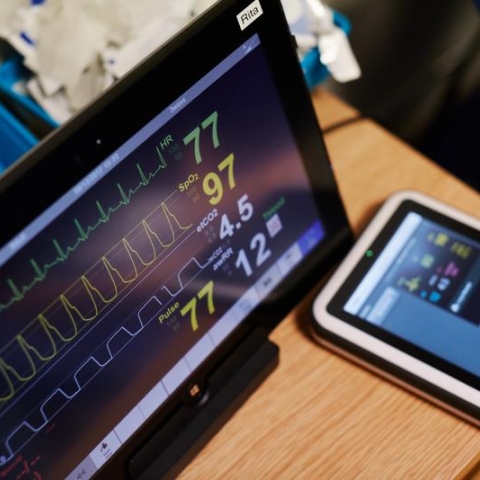
We're researching the effective design and use of IT in health and social care to improve how practitioners communicate with patients and to promote patient wellbeing

Clinical Outcome Modelling
We're developing and evaluating mathematical and computer models, and collaborating with the NHS, to help make accurate healthcare predictions using health data science. Explore our clinical outcome modelling research.

Ambient Assisted Living
We're exploring the use of technology in people’s daily lives to promote independence and wellbeing
Research degree options in Health informatics
We offer several postgraduate research routes in Health informatics, including PhD, MPhil and PhD by Publication. Find out about our research degree opportunities below, including how to apply, entry requirements and funding your degree. You can apply for an existing project or propose your own research idea. For more detailed information about the application process, visit our How to Apply pages.
Available PhD and MPhil projects
You can apply for a pre-approved PhD or MPhil project, or develop your own research proposal.
There are currently no funded PhD projects available in this area — for more information on funding your own research project, visit our pages on funding your research degree.
- Ambient Assisted Living Technologies
- Analytics Theory and Applications for Teaching Children with Autism Spectrum Disorder
- Best practice on design of personal health records: Practitioners perspectives and experiences on improving quality of care
- Clinical data science
- Data fusion and multimodal learning for Ambient Assisted Living
- Development of a framework for AI risk assessment in terms of user’s personalities
- Development of a quality labeling system for mhealth applications
- Development of AI/ML technologies to identify breathing pattern disorders
- Development of computable knowledge artifacts using the DAK model
- Outcome and Mortality Prediction in Intensive Care Units using Machine Learning
- Understanding the barriers to M-Health adoption in older people
If you already have a research idea, find a supervisor whose research interests match yours by searching our Find a PhD Supervisor page. Once you've identified someone suitable, contact them to discuss your idea.
PhD by Publication
A PhD by publication is a postgraduate research degree based on research you've already undertaken and had published (excluding self-publishing) before registering with us.
Eligible research outputs include peer-reviewed academic papers, complete books or chapters in anthologies, and other materials accepted for publication, exhibited or performed. You'll have to submit these materials for examination between 6–12 months after registering with us.
From October 2026, all PhD by Publications will be completed by distance learning. However, there is no expectation that any student applying for a start date before this should be on campus.
Entry requirements
The entry requirements for a PhD, MPhil or Professional Doctorate include an upper second class honours degree or equivalent in a relevant subject, or a master’s degree in an appropriate subject.
Equivalent professional experience and/or qualifications may be considered. All applicants are subject to interview.
If English is not your first language, you'll need English language proficiency at a minimum of IELTS band 6.5 with no component score below 6.0.
If you don't meet the English language requirements yet, you can achieve the level you need by successfully completing a pre-sessional English programme before you start your course.
Fees and funding
April 2026
-
Full-time and full-time distance learning: £5,006 per year (may be subject to annual increase)
- Part-time and part-time distance learning: £2,503 per year (may be subject to annual increase)
(Including EU Scholarship)
- Full-time and full-time distance learning: £5,006 per year (may be subject to annual increase)
- Part-time and part-time distance learning: £2,503 per year (may be subject to annual increase)
- Full-time and full-time distance learning: £19,200 per year (may be subject to annual increase)
- Part-time and part-time distance learning: £9,600 per year (may be subject to annual increase)
- External candidates: £5,006
- Members of staff: £2,000
- All fees are subject to annual increase. If you are an EU student starting a programme in 2025/26 please visit this page.
October 2026 and February 2027
-
Full-time and full-time distance learning: £5,238 per year (may be subject to annual increase)
- Part-time and part-time distance learning: £2,619 per year (may be subject to annual increase)
- Full-time and full-time distance learning: £19,950 per year (may be subject to annual increase)
- Part-time and part-time distance learning: £9,975 per year (may be subject to annual increase)
EU students may be eligible to receive our EU Scholarship.
- Full-time and full-time distance learning: £19,950 per year (may be subject to annual increase)
- Part-time and part-time distance learning: £9,975 per year (may be subject to annual increase)
- External candidates: £5,238
- Members of staff: £2,100
- Tuition fees terms and conditions
Additional fees
Some PhD projects may include additional bench fees for equipment and other consumables. These will be added to your standard tuition fee. Speak to the supervisory team during your interview about any additional fees you may have to pay. Please note, bench fees are not eligible for discounts and are non-refundable.
Funding support
Government Postgraduate Loan
Eligible for MPhil full-time and part-time courses (UK/EU students).
Other funding options
For information on other sources of funding, visit our funding your postgraduate research degree page.
What do my tuition fees cover?
If you are self-funding your PhD, your tuition fees cover the full cost of your postgraduate research programme and access to a wide range of academic, professional and support services, including:

Research training and development
Bespoke training, professional development courses, seminars, workshops and researcher-led events delivered through The Doctoral College.

Research community and support
Access to our research environment, Research and Innovation services, and researcher networking (77% of our research is world-leading or internationally excellent, REF 2021).

Facilities, equipment and resources
Libraries, laboratories, computer rooms, laptops, electronic journals, specialist software (Microsoft Office, SPSS and Adobe Creative Suite), funding guidance and LinkedIn Learning. Explore our facilities.

Student support services
Including academic, financial, careers and wellbeing support, including access to personal tutors. Read more on our guidance support.

Your PhD programme
Registration, tuition, supervision, examinations and viva administration.

Conference and development support
A contribution towards attending conferences or research-related development activities.

Students' Union membership
Giving you the right to vote in elections, join clubs and societies, and get free independent advice.

Graduation
Your graduation ceremony will recognise the significant contribution your research has made to your discipline.
Support and facilities
-
Support from our Doctoral College, helping you become part of a thriving, collaborative research community
-
Guidance from a dedicated supervisory team throughout your research degree
-
Access to the Doctoral Development Programme, offering specialist training, workshops and research events to develop your skills as a researcher
-
Access extensive resources including a Clinical Skills Laboratory, Digital X-Ray Suite, Virtual Environment Radiotherapy Training (VERT) System, and Ultrasound Room.
-
Our Centre for Simulation in Health and Care offers you the opportunity to develop practical skills for working in health-related sciences in a safe learning environment.
-
Access simulation facilities that mirror current clinical equipment and healthcare environments.
What can a postgraduate research degree do for my career?
A postgraduate research degree develops advanced expertise and transferable skills valued across academia, industry and the public sector.

You’ll graduate with:
-
Advanced research and analytical expertise
-
Critical thinking and problem-solving skills
-
Experience managing complex, independent projects
-
Strong communication and presentation skills
-
Leadership and research management capability
-
Deep subject knowledge in your chosen field
How to apply
You can apply for a research degree in Health informatics by completing our online application form. For more detailed information about the application process, visit our How to Apply pages.
Not ready to apply just yet?
Get in touch
We're here to help. Feel free to ask us a question.
Come to an Open Evening
Why not come to our next open evening? Open evenings are the perfect place to talk to staff and students, visit our campus and get all the information you need.

- MPhil: 2 years full-time, 4 years part-time
- PhD: 3 years full-time, 6 years part-time
- PhD by Publication: 1 year part-time
We recommend you get in touch with the relevant subject area supervisor using our “Find a Supervisor” tool ahead of applying. You can discuss your research ideas with them and ensure we have supervisory expertise to support you.
Yes. You can apply with your own research proposal, or apply for one of our advertised funded projects.
Where next?
Find out more about Portsmouth's postgraduate opportunities and community.
Postgrad Research Degrees Webinar series
From applications to flexible study — get the insights you need to plan your research degree.

Find a PhD Supervisor
If you've already got your own research idea, start looking for a supervisor whose research interests match yours.

How to apply for postgraduate research
Read our guide on how to complete and submit your postgraduate research application. Take the next step in your academic career today.
